
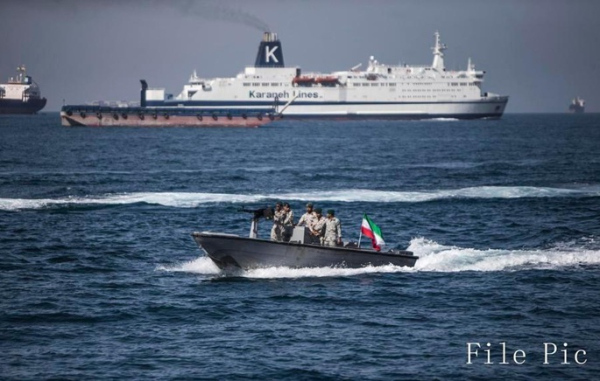

The German government on Monday rejected a call by US President Donald Trump for NATO allies to help protect commercial shipping in the Strait of Hormuz from Iranian attacks in a bid to bring down soaring oil prices, reported dpa.
"This war has nothing to do with NATO. It is not NATO's war," government spokesman Stefan Kornelius said in Berlin, as many of Washington's Western allies suggest that the US and Israel have no one but themselves to blame for the turmoil on global oil markets triggered by their war on Iran.
Trump, who has repeatedly asked allied nations to support a military mission in the Strait of Hormuz, on Sunday ramped up his rhetoric towards NATO, suggesting that the alliance might face a "very bad future" if allies don't help ensure safe passage for commercial shipping through the narrow waterway between Iran and Oman.
"It's only appropriate that people who are the beneficiaries of the Strait will help to make sure that nothing bad happens there," he told the Financial Times in a eight-minute phone conversation.
While many in the 32-member defence alliance, including Germany, have agreed that the leadership in Tehran poses a threat, allies are increasingly criticizing Trump over what they see as a lack of strategy to bring the war to an end.
When asked about Trump's threats, the spokesman merely said the German government had taken note of them.
Kornelius stressed that the purpose of NATO is the defence of its territory and there was currently no mandate to deploy NATO forces to the Middle East.
German Defence Minister Boris Pistorius also rejected NATO involvement in the Strait of Hormuz, making the same argument.
"This is not our war; we did not start it," he said during a meeting with his Latvian counterpart Andris Sprūds in Berlin.
"We want diplomatic solutions and a swift end to the conflict, but sending more warships to the region is unlikely to help."
While NATO allies share the goal of bringing the Iranian regime to an end, the manner in which the US and Israel are trying to achieve this is debatable, Pistorius suggested.
"The Americans have opted for this path, together with the Israelis. We have criticized this only very moderately. But the next step is one that now threatens to drag us into this conflict."
German Foreign Minister Johann Wadephul, speaking on the sidelines of an EU meeting in Brussels, also rejected Trump's demands.
"I also don't see that NATO has made any decision in this direction or could become responsible," Wadephul said.
Cross-party consensus
There also appears to be a cross-party consensus in Germany that European warships should not be deployed to the Strait of Hormuz.
Jürgen Hardt, foreign policy spokesman for Chancellor Friedrich Merz's conservative bloc, argued on Monday that navy units would not suffice to secure the narrow waterway, a crucial chokepoint for global oil supplies.
The region's coastline is densely populated, and Iran could easily launch attacks from the mainland using mortars or simple drones, Hardt told the Deutschlandfunk radio station.
"Ships alone won't do the trick. Donald Trump didn't take that into account when he started this war against Iran alongside Israel," he added.
Hardt said it appeared that Trump does not know how to solve the issue.
"I would suggest that we simply have to accept that the route will remain closed until there is some sort of change in Iran," he said, suggesting some sort of ceasefire between the US, Israel and Iran or the overthrow of the Iranian leadership as the most likely scenarios.
Adis Ahmetovic, foreign policy expert for the Social Democrats, the junior partner in Merz's government, said Trump appeared to have miscalculated.
The US-Israeli campaign against Iran launched on February 28 "was initially intended to be a very swift, short war," he told public broadcaster ZDF. "And we are now seeing that this war will drag on for several more weeks."
He added that while the German Navy is very capable and has special skills, its capabilities are not geared towards participating in such a scenario at present.
Alice Weidel, co-leader of the far-right Alternative for Germany, told The Pioneer that not even the US Navy, the world's largest, was capable of ensuring safe passage through the Strait of Hormuz.
This means a deployment of the "small German Navy – even within the framework of the EU – would be illusory and highly dangerous," she added.
- Germany
- Rejects
- US
- Hormuz
Source: www.dailyfinland.fi
