
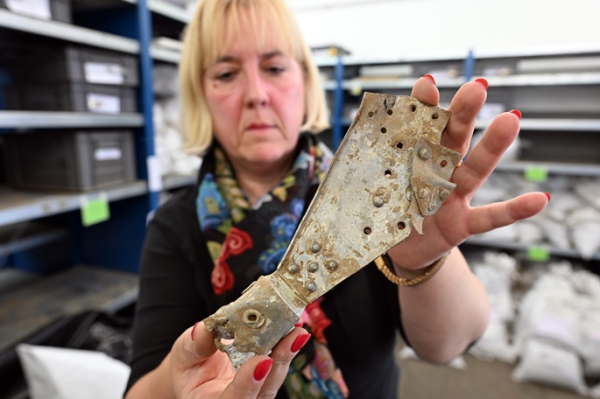

Aircraft debris have been discovered in an open-cast mine in western Germany – presumably of a British military bomber crashed in 1943. The World War II wreckage will soon be preserved in a museum.
Archaeologist Tünde Kaszab-Olschewski usually focuses on clay pots, coins and graves – but she found herself dusting soil off a military plane last year.
She is a specialist in finds from the Roman period, handling objects that are more than 1,000 years old.
But she found that working on an excavation near a lignite open-cast mine stirred up deep emotions.
"I couldn't help myself," she says, placing a candle in the middle of the grey landscape full of earth, coal and stones at the Hambach open-cast mine, deep in rural Germany.
She is part of a team unearthing the remains of a British military aircraft that crashed 82 years ago, in the turmoil of World War II.
The aircraft, a Short Stirling, was one of the largest British bombers in the war.
Before this particular plan crashed, three soldiers parachuted out and survived. Four others are still missing.
All their names are known. Photos of the crew show young men in their mid-20s with smooth faces.
At the crash site, excavation technicians from the Rhineland Regional Council's Office for the Preservation of Archaeological Monuments (LVR) found many metal parts as well as human remains, presumably of the crew members.
Report on the crash
It was known that a British bomber had crashed in the rural area on the night of July 31, 1943, thanks to eyewitness reports. One of the surviving British soldiers later wrote an essay about the accident and his captivity as a prisoner of war.
"We provided the tip," says Jörg Dietsche from the Rhine/Moselle Air War History Working Group. The group aims to help shed light on unexplained aviation fates between 1939 and 1945 and searched for the crash site at the request of archaeologists.
Soon, the first metal parts emerged and those at the site unearthed a piston from the aircraft engine.
Later, they found bones, Dietsche says. Once it was clear that the aircraft belonged to the Royal Air Force, he contacted the British Embassy in Berlin to reach the British authorities.
No homicide squad required
The rules meant archaeologist Tünde Kaszab-Olschewski had to report the bone find to the police. "Once it was possible to date the bones to World War II, there was no need to call in the homicide squad," she says.
The archaeologists have now completed their work at the site near the Hambach open-cast mine. After a week there, excavation technicians Daniel Gansera and Mathis Laux have moved on to seek out traces of the past at other sites.
Debris for the museum
Behind a closed door at the Titz branch of the Rhineland Office for the Preservation of Archaeological Monuments are 17 large plastic crates containing small pieces of metal debris from the site. You can still see a screw attached to a bent piece of metal, and a piece of Plexiglas has burn marks.
Many finds from the British World War II bomber will be taken to Bonn to the LVR State Museum, where they will be processed and exhibited.
Other exhibits will be given to the Air War History Working Group on permanent loan. And the association of private individuals interested in history is planning a permanent exhibition at Vogelsang IP in the Eifel region. Later on, they jope to create a documentation centre on the air war.
For now, the remains are stored in a warehouse in Titz. The next step is to carry out a DNA analysis of the bones, says the archaeologist. Officially, four crew members who are presumed to have died in the crash are still missing.
But the discovery of a shoe sole, the remains of a uniform jacket with a cigarette case and parachute accessories persuaded the archaeologists that they have now found their remains.
It was moving on a personal level, says the archaeologist. "We want them to be buried."
- Archaeologists
- Wreckage
- British WW II plane
Source: www.dailyfinland.fi
